
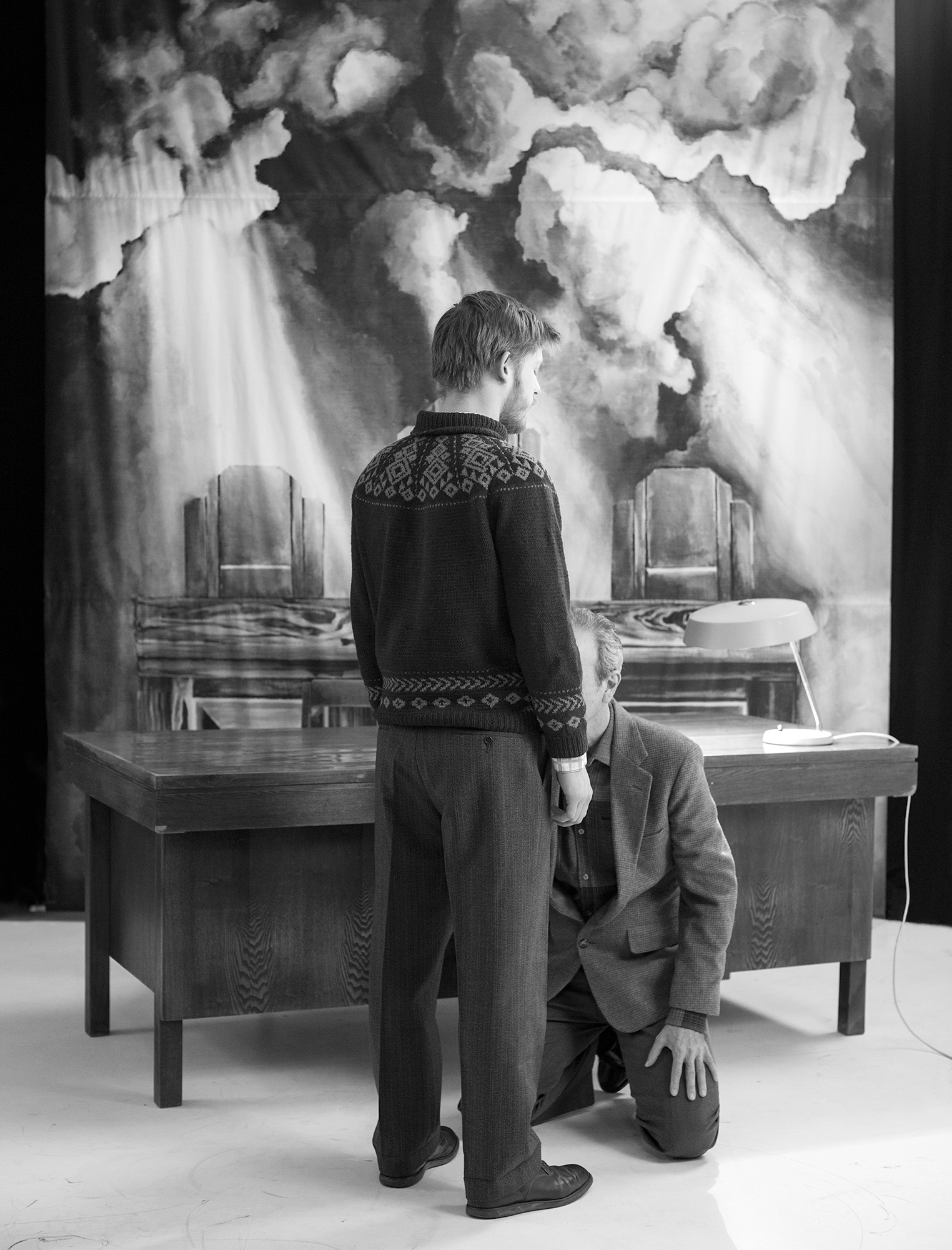
An archival court case file revealed the lives of gay men. Artist Jaanus Samma brought his interpretation of the story into the exhibition space.
Most socially active gay men in Tartu had heard of The Chairman. During the 1970s and 1980s, his home was one of their main gathering places. Many did not even know the former collective farm chairman's real name—using nicknames was simply safer.
After interviewing older gay men, artist Jaanus Samma heard numerous intriguing stories and legends about The Chairman and decided to learn more about him. Samma's archival research uncovered documents revealing different facets of the man's life. The most significant discovery was a criminal case brought under Article 118 of the Criminal Code of Soviet Estonia, which criminalised penetrative sexual relations between men.
"It was pure chance that, among the few surviving case files related to this article, the most extensive one concerns The Chairman," Samma says. "The 330-page file examines the sex life of two people in extraordinary detail. The authorities' determination to eliminate ways of life that deviated from the official norm paradoxically resulted in those lives being placed under a magnifying glass, turning the most ordinary aspects of private life into matters of state."
As a result of the trial, The Chairman was dismissed from his position as the head of a collective farm in the late 1960s and sentenced to eighteen months in prison. He died tragically in 1990.
According to Samma, The Chairman's story encapsulates many of the defining experiences and darker realities of gay life in the Soviet period, making it, in many ways, a distillation of that history.
"Finding the right key to tell the story in all its complexity—without losing its central thread or its historical lesson—was a real challenge," he explains.
To Samma, The Chairman's turbulent life resembles the plot of a classical opera. As part of his doctoral research, he presented The Chairman: An Opera at the 2013 Köler Prize exhibition at the Contemporary Art Museum of Estonia (EKKM).
The work featured black-and-white photographs from an imagined stage production in which an actor reenacted pivotal moments from The Chairman's life. Another installation, The Box, invited visitors into a baroque opera box opening onto darkness, where they could listen to a composition by Johanna Kivimäe written specifically for this artwork, echoing the atmosphere of an operatic overture.
The project later evolved into the exhibition NSFW. A Chairman's Tale, which premiered in the Estonian Pavilion at the 56th Venice Biennale. Archival documents and photographs portrayed life on a collective farm in the 1960s as well as Tartu's well-known gay cruising locations, including the Annelinn public sauna and the ruins of Tartu Cathedral. As an artistic interpretation of the archival material, videos created in collaboration with Marko Raat reenacted events described in the court records.
According to Samma, these works intertwine the personal with the universal, individual lives with broader historical narratives, and the past with the present.
"These exhibitions seek to recover the silenced history of discrimination, to remember it, and to draw attention to a problem that, unfortunately, has not disappeared."
As an artist, Samma says he enjoys greater interpretive freedom than a historian.
"I can say things that a historian cannot always allow themselves to say."
For him, this is one of the key reasons—and one of the greatest strengths—of choosing artistic research as his approach.
According to Samma, great art emerges when an artist immerses themselves deeply in a subject and ventures beyond the obvious. Scientific methods, he believes, are an excellent way of achieving exactly that.
.jpg "Foto: Reimo Võsa-Tangsoo")
