
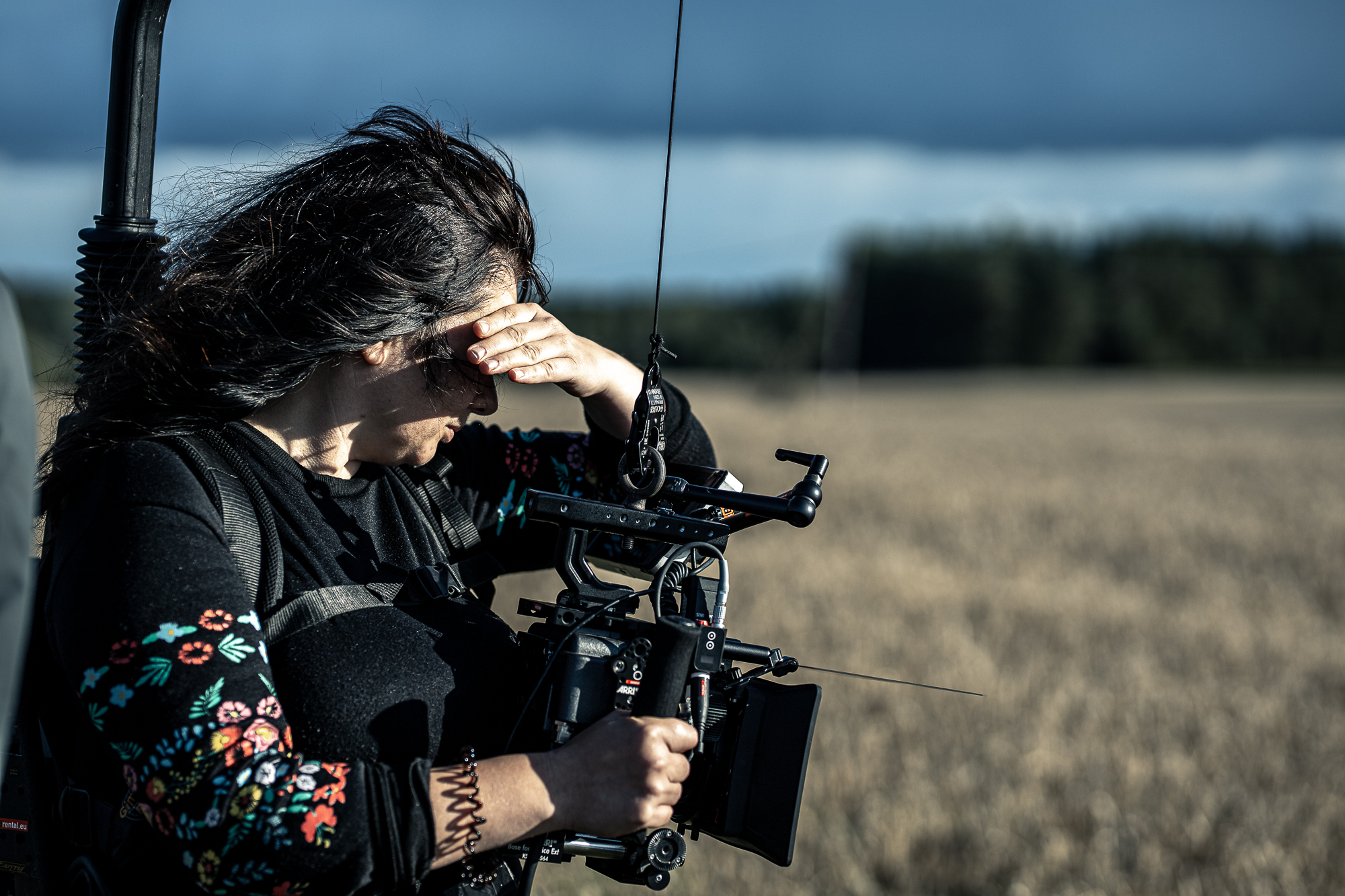
In her doctoral research, Elen Lotman explored the intuitive decision-making that guides cinematographers.
Camera work shapes the viewer's relationship with the characters on screen. Does it evoke empathy or indifference? How does it influence the mood and rhythm of the story? A film's visual language is just as important as its narrative, because form and content are inseparable.
Every cinematographer develops an intuitive body of tacit knowledge - a professional instinct refined through years of successes and failures in practice. After nearly twenty years working as a cinematographer, Elen Lotman set out to investigate how this professional heuristic is formed.
Her hybrid doctoral project resulted in three scholarly articles, an analytical dissertation, and the feature film Goodbye, USSR (directed by Lauri Randla, cinematography by Elen Lotman). Much of the research draws directly on Lotman's own professional experience.
Although every film and every creative process is unique, Lotman's research demonstrates that cinematographers share certain recurring patterns of thinking. She describes these as alternating phases of expansion and contraction.
"Creative and original ideas require a phase of expansion," Lotman explains.
Traditionally, cinematographers preparing for a film would visit art exhibitions, observe everyday life through the lens of the future film, and gradually build an intuitive visual vocabulary. They would walk through cities and landscapes with cameras, collecting images and impressions.
Today, however, the creative process is increasingly mediated by computers. Visual references are primarily sought online, using databases of existing film stills and algorithm-driven search tools. While these resources make research more efficient, they also increase the likelihood of reproducing familiar visual solutions rather than discovering genuinely new ones.
"Everyone needs to develop their own methods, but we should avoid falling into the trap of convenience," says Lotman. "Recognising and exploring the chaotic element hidden within divergent thinking is essential."
According to Lotman, original thinking has become even more valuable in the age of artificial intelligence, as it helps creative practitioners maintain their autonomy alongside increasingly accessible digital tools.
During the phase of expansion, creative chaos grows. This is gradually reduced until the process enters a phase of contraction, where concrete creative decisions are made. Lotman also examines how the brain deliberately generates a degree of internal chaos in order to establish new connections.
Originality, however, should not overshadow familiar cultural references.
"The repetition of recognisable cultural signs is necessary if a work of art is to be meaningful," she argues.
Lotman draws on Juri Lotman and Yuri Tsivian's Dialog with the Screen, in which culture is described as the collective brain of humanity—a system that stores and processes information. Within this cultural brain lies a creative centre capable of generating new meanings: this is the role of art. Whatever has no alternative becomes mere automatism. Because art creates "possible worlds," it allows us to perceive the existing world from alternative perspectives.
Artistic choice, therefore, is fundamentally an act of creating new meanings. As a synthetic art form combining multiple artistic disciplines, cinema occupies a particularly significant position as a generator of new meanings today.
The information age has also brought increasing specialisation among both researchers and artists, making their work difficult to understand outside their own fields. Lotman argues that new models are needed to bridge disciplinary boundaries. Artistic research provides one such model, bringing together specialists from different fields to examine a shared phenomenon and generate new knowledge that is essential for human progress.
"Problems can only be solved through new ideas, not the ones we already have. New ideas emerge by creating connections between elements that have not previously been linked," Lotman concludes. "Creators who work intuitively do this without being consciously aware of it."