
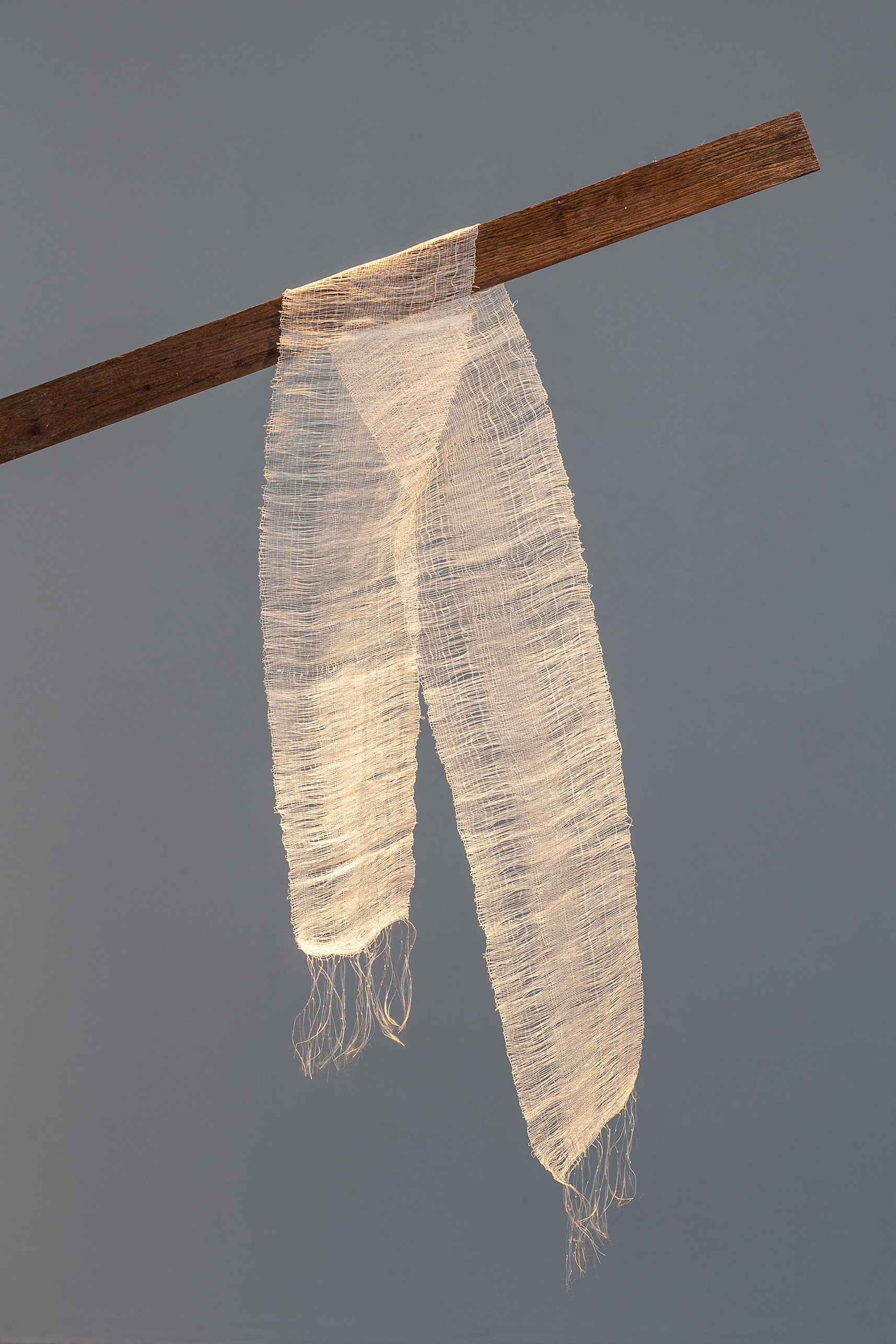
Textiles do not have to be static or passive. Artist and designer Kärt Ojavee shows how to bring textiles to life, making them dynamic and responsive.
Kärt Ojavee has long been fascinated by active textiles that can be controlled and programmed. For her doctoral research, she experimented with interactive fabrics that gradually respond to changes in their environment by displaying evolving patterns across their surface.
Among Ojavee's creations is an award-winning textile that reveals a pattern resembling tiny cells when touched. The motif continues to spread across the fabric for as long as the hand remains in contact with it. Another soft textile she developed reveals playful patterns when someone sits on it.
"Touch is one of the most powerful forms of mediation, while at the same time being deeply personal and intimate," Ojavee writes in her doctoral dissertation.
In collaboration with neuroscientist Jaan Aru, she also created two interactive cushions. One gradually illuminates to reveal the layered patterns hidden within it, while the other produces sound. Ojavee believes these objects could serve as comforting companions or educational tools for children with disabilities.
For Ojavee, an active and programmable textile surface offers a subtle yet powerful way of visualising information and shaping the spaces we inhabit. Her research concludes that textiles can function as dynamic interfaces for communicating information, including through slow technology, functional patterning, and interactive behaviour.
The objects she has developed are equally suited to exhibition spaces, public waiting areas, schools for children with profound and multiple disabilities, and healthcare environments.
As part of her doctoral research, Ojavee also proposed a novel design methodology for active smart textiles. She divided the design process into a series of stages in which material design, interaction design, electronics, and programming are integrated. Combining design methods with approaches from computer systems design, she developed a new framework for creating hybrid materials and defining design concepts.
"It was artistic research that at times became highly technical," Ojavee reflects.
Her research involved constant iterative refinement, as she wrote the theoretical part of her dissertation while simultaneously experimenting with materials. In her view, interactive textiles have considerable untapped potential, particularly in education and healthcare, where they deserve further exploration.

