Marion Jõepera explored how language and dramaturgical strategies can shape people's perception of space.
How can we break free from the perceptually dulled state that we all occasionally find ourselves in?
In her doctoral research, copywriter and hiking guide Marion Jõepera investigated how dramaturgically designed environments can create moments of heightened awareness by using linguistic and dramaturgical techniques.
She was interested in how dormant spatial awareness can be awakened and to what extent people's perception of space can be guided through language. For example, spatial perception can be transformed by directing a person's attention with extreme precision towards sensations within their own body. Likewise, language can move unexpectedly between the future and the past, creating a spatial experience reminiscent of memory and dreams.
There are many such techniques. Jõepera identified seventeen in total, selecting four for practical experimentation and applying each of them in a separate creative work.
Her first creative project consisted of two dramatic texts structured according to principles of musical dramaturgy. The short play Anacrusis was based on the compositional structure of Israeli jazz musician Avishai Cohen's Seven Seas, while Ars Arctica drew on Arvo Pärt's Variations for the Healing of Arinushka. Both texts were constructed using principles derived from musical composition and were performed at the Drama School of the Estonian Academy of Music and Theatre.
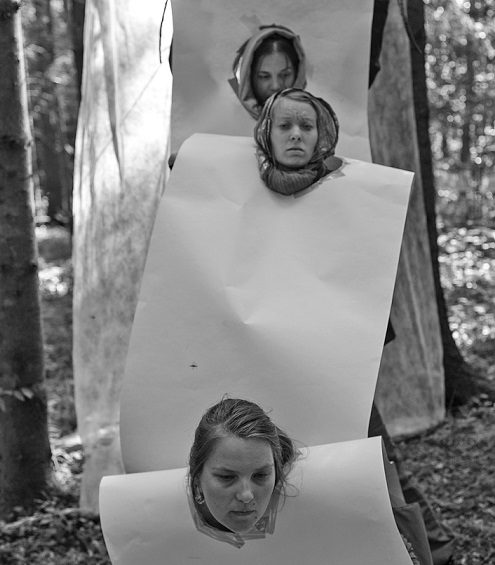
The second creative work was the performance Wild Wild City, staged twice in radically different locations: once on the rooftop of Viru Centre in central Tallinn and once deep in the forest. Jõepera explored how chance emerges and how audiences' perception of space changes when identical dramaturgical structures unfold in entirely different environments.
Her third project, Surrogate Forests, was a psychogeographical podcast game. Participants navigated a location of their own choosing while following audio instructions that encouraged them to discover familiar surroundings from unexpected perspectives.
The fourth creative work likewise invited participants to engage actively with their bodies, using physical movement as a means of directly transforming their perception of space.
"All of these techniques served the same purpose: to create a sudden shift in the participant's perception of the state they are in," Jõepera explains.
According to her, moments of interruption are precisely when our direct perception of the world becomes most intense.
Jõepera believes that making one's own choices while moving through space is one of the most natural forms of human experience. She argues that people possess an innate desire for exploration and playfulness that cannot be satisfied by spending an increasing amount of time in virtual environments.
At the same time, she points out that many of the choices and pathways available in today's urban environments and service spaces are, in fact, carefully designed in advance. For this reason, the linguistic and dramaturgical techniques she identified have applications well beyond theatre, including service design and education.
"More broadly, I wanted my doctoral research to demonstrate that dramaturgs' knowledge and skills can be applied far beyond theatre," Jõepera concludes. "In particular, they have great potential in the design of services and environments."