
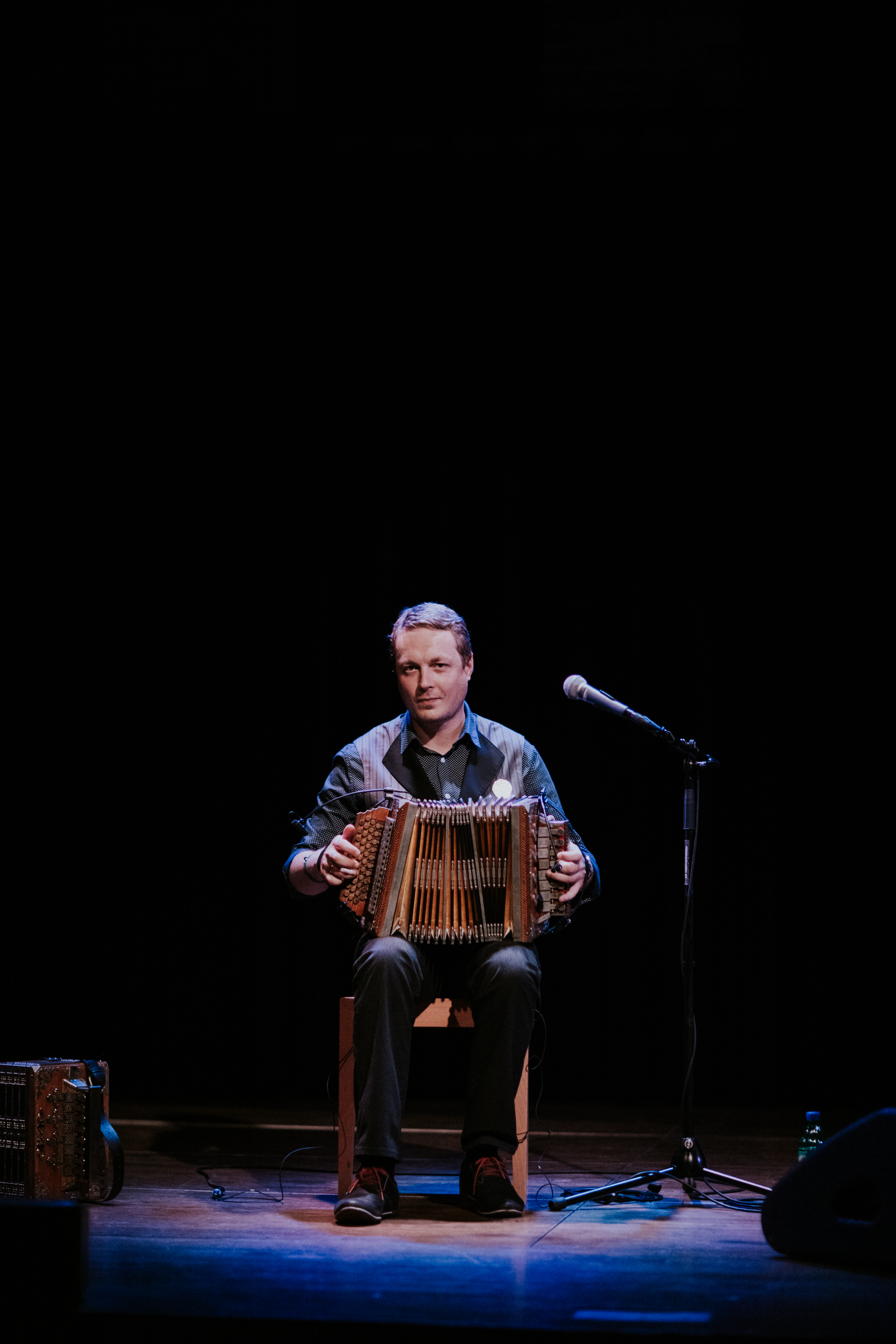
Juhan Uppin Demonstrated Traditional Accordion Playing Techniques
The lõõtspill, a traditional Estonian diatonic button accordion, was one of the most popular musical instruments in Estonian villages during the nineteenth century. Its powerful sound, produced by compressing and expanding the bellows, made it ideal for accompanying dancing and quickly bringing village celebrations to life. Manufactured in factories in Russia and Germany, the instrument was also relatively easy to repair, contributing to its remarkable popularity throughout Estonia.
Despite its central place in Estonian musical culture, the lõõtspill had never been studied in depth. Musician and professional accordion player Juhan Uppin set out to change that through his doctoral research.
"I wanted to learn to play the instrument the way it was played a hundred years ago," Uppin explains.
At the time, the instrument's primary role was to get people dancing at village festivities. It did not become a concert instrument until the 1930s.
Uppin's research combined musical analysis with self-reflection as a performer. He transcribed historical recordings dating from 1954–1995 and 2009, focusing on influential musicians including August Teppo, Elmar Lindmets, Richard Reino, Karl Kikas, Arnold Pärnamets, Kalju Sarnit, and Aivar Teppo. By identifying stylistic elements rooted in playing technique, he analysed both historical performance practices and his own creative development as a musician. The research culminated in a series of concert performances.
According to Uppin, reconstructing historical performance practice depends on two essential components: the artistic research-based analysis of archival recordings of traditional music and a conscious understanding of one's own creative practice.
"Examining musical works in detail helped me better understand their structure and internal logic," Uppin says. "It also helped me understand how the musicians I studied thought."
Throughout the research process, Uppin became consciously aware of many intuitive observations that had emerged during his years as a performer. By approaching the development of his own musical style more systematically, he was able to refine and deepen these insights.
"A more conscious approach to shaping my own style has enriched those intuitions," he concludes. "It is also an invaluable skill when teaching others to play the instrument."
